








Every year, millions of people pay dental insurance premiums faithfully, only to discover their coverage runs out right when they need it most. The reality of dental insurance is often more complicated than the brochure suggests, and for many patients, the math simply does not add up. When you factor in premiums, deductibles, annual maximums, and the long list of treatments that are denied or only partially covered, you may be spending more than you realize while receiving less care than you deserve.
At Club K Holistic Dental in Springfield, Missouri, Dr. Joshua Knapton has deliberately chosen to operate outside dental insurance networks, and his reasoning goes far deeper than convenience. As the only biological ceramic doctor in the Springfield area, Dr. Knapton built his practice around whole-body, biocompatible care grounded in the principles of holistic dentistry. The fee-for-service model is not a limitation. It is a reflection of his commitment to placing patient health above insurance-driven restrictions.
How Dental Insurance Annual Maximums Work Against You
Most people assume dental insurance functions like medical insurance. It does not. A typical dental plan carries an annual maximum of $1,000 to $1,500, meaning the insurance company will pay no more than that amount on your behalf each year, regardless of what you need. Once that ceiling is hit, every remaining cost falls entirely on you. The American Dental Association has noted that annual maximums remain a significant barrier to dental care, with the financial burden increasingly shifting onto patients as they approach their coverage limits.
The Real Cost of “Having Coverage”
Consider a patient paying monthly dental insurance premiums. After meeting a deductible, insurance typically covers 100% of preventive care, 80% of basic procedures, and only 50% of major work. A single crown, implant, or other significant treatment can cost more than the annual maximum itself, meaning insurance covers only a fraction of the cost. At the same time, the patient absorbs the rest, on top of all those monthly premium payments. For many people, the total spent on premiums and out-of-pocket costs each year may rival or exceed what they would have paid by simply paying for care directly.
What Insurance Will and Will Not Cover
Dental insurance often has strict rules about what it will and will not cover, and many holistic or biocompatible treatments do not make the list. Options such as metal-free restorations, ceramic implants, ozone therapy, and other biologically focused procedures may be denied, labeled as cosmetic, or covered at a much lower rate. That can be frustrating for patients who are trying to choose materials and treatments that better support their long-term health.
What Fee-for-Service Dentistry Actually Means for You
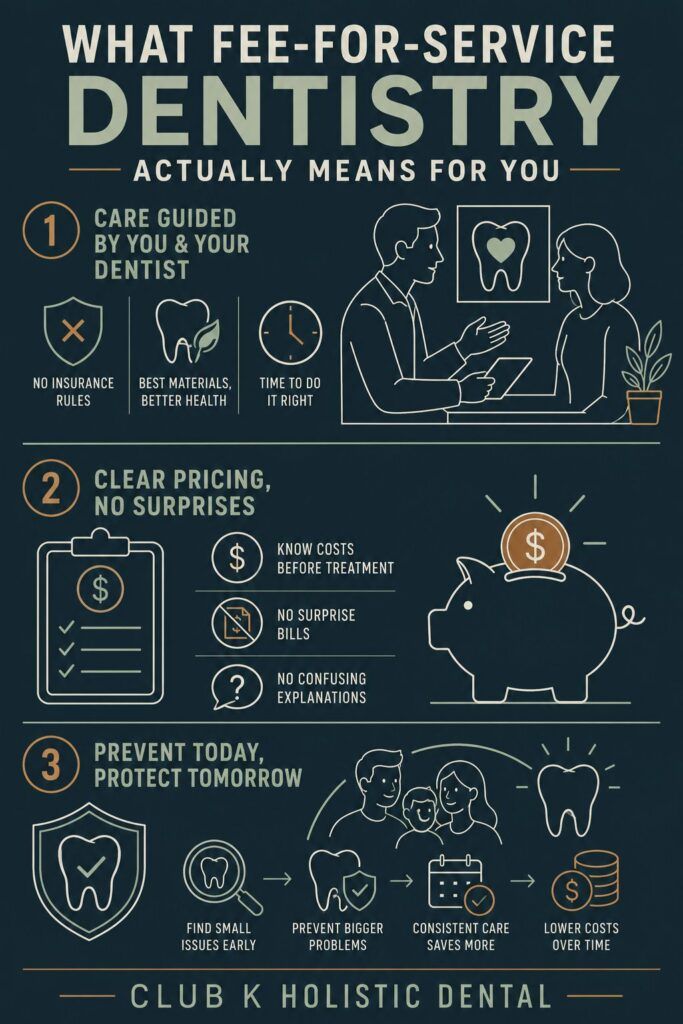
In a fee-for-service practice, there is no insurance company dictating which treatments are approved, which materials may be used, or how quickly a procedure must be completed. The conversation about your dental health stays where it belongs, between you and your dentist.
Dr. Knapton takes the time needed to evaluate your full health picture, recommend treatments based on what your body actually needs, and use the highest-quality biocompatible materials without seeking third-party authorization. Clinical judgment, not coverage tiers, drives our dental services.
Transparency in Pricing
One of the most underappreciated benefits of fee-for-service care is pricing transparency. Before treatment begins, you know exactly what something costs. There are no surprise bills weeks later, no confusing explanations of benefits, and no disputes over what was pre-authorized. Our services and pricing page gives patients a clear starting point so they can make informed decisions without waiting on an insurance company to weigh in.
Preventive Care as the Real Investment
Insurance models often incentivize reactive care because that is where the billing happens. A preventive approach is different. When preventive dentistry is the foundation of your care, the goal is to identify and address small problems before they become expensive ones.
Routine exams and cleanings allow Dr. Knapton to monitor your oral health holistically, catch early warning signs, and help you avoid major procedures that would exhaust any insurance plan. Investing in prevention consistently costs far less over time than managing the consequences of delayed or insurance-limited care.
Is Fee-for-Service Right for You?
This is a fair question, and the answer depends on your individual health needs and how you currently use your dental benefits. For patients who primarily use their insurance for twice-yearly cleanings and occasional fillings, the math may look fine on the surface.
Thinking About Making a Change to Your Dental Health?
Club K Dental offers a holistic, whole-body approach to dentistry in Springfield, MO. Whether you're exploring ceramic implants, fluoride-free care, or simply looking for a dentist who listens — we'd love to meet you.
However, for anyone who values biocompatible materials, wants access to advanced holistic treatments, or has more significant dental needs, the gap between what insurance covers and what it costs can be significant. Many of our patients have found that redirecting premium payments toward actual care at a practice designed around their whole-body health gives them better outcomes and clearer finances.
Choose Whole-Body Dental Care at Club K Holistic Dental
Dr. Joshua Knapton earned his dual DMD and MBA from Roseman University of Health Sciences and holds memberships in the IAOMT and AGD, as well as BioClear and Swiss Dental Solutions certifications. His training in biological and preventive dentistry informs every recommendation made in our practice. Fee-for-service care is not about excluding patients. It is about removing the barriers that prevent them from receiving the care their health actually requires.
If you are ready to experience dentistry that puts your well-being first, we invite you to contact our team and schedule a visit. At Club K Holistic Dental, your care is never decided by an annual maximum.
Frequently Asked Questions About Fee-for-Service Dentistry
Can I still use my dental insurance at a fee-for-service practice?
Many fee-for-service practices, including Club K Holistic Dental, can provide documentation you can submit to your insurance company for potential out-of-network reimbursement, even though they do not bill insurance directly. Reimbursement amounts vary by plan, so it is worth checking your specific out-of-network benefits.
Can I use my HSA or FSA at a fee-for-service dental practice?
Yes, in most cases. Health savings account and flexible spending account funds can typically be used for dental treatment regardless of whether a practice accepts insurance directly, since these accounts are based on the type of care received rather than network status.
Why do some biocompatible treatments cost more out-of-pocket?
Insurance plans often categorize treatments like ceramic implants, metal-free restorations, or ozone therapy as elective or cosmetic, which limits or eliminates coverage regardless of their clinical value. Fee-for-service care allows these options to be recommended based on your health needs rather than what an insurance policy defines as covered.
Is fee-for-service dentistry more expensive overall?
Not necessarily. When you account for monthly premiums, deductibles, and the portion of major procedures insurance does not cover, many patients find the total annual cost is comparable to or less than what they were paying with traditional insurance, especially once low annual maximums are factored in.
How do I know if fee-for-service care is right for my situation?
Patients who mainly need routine cleanings may find their current insurance works fine, while those with more significant dental needs or an interest in biocompatible materials often find more value in fee-for-service care. Reviewing your own dental history and priorities with a member of our team can help clarify which approach fits you best.