






Medically Reviewed by Dr. Joshua Knapton, DMD on July 15, 2026
The debate over amalgam has been going on since the 1800s. It has never fully resolved, and it probably will not. What has changed is the range of metal-free alternatives that match amalgam for durability and surpass it on biocompatibility. Ceramic and composite resin restorations have crossed the threshold where patients no longer have to trade durability for a safer material. Both are available, and at Club K Dental, both are what we use.
Dr. Joshua Knapton built this practice around the principle that what goes into your mouth ends up in your body. He is the only biological dentist within an hour of Springfield, Missouri offering the full spectrum of metal-free restorative options at our holistic dental practice in Springfield. If you are ready to review what is in your mouth and decide what to do about it, contact our office to schedule a consultation.
What Are Metal-Free Dental Restorations?
The phrase covers more ground than most patients expect. A composite resin filling is metal-free. So is a ceramic inlay or onlay, an all-porcelain crown, a zirconia bridge, and a ceramic implant that replaces the entire tooth from root to crown with no titanium or metal alloy involved. None of these materials corrode, none of them carry mercury, and none of them create the galvanic reactions you get when dissimilar metals sit in the same mouth for years.
Zirconia is harder than steel. It does not conduct heat and cold the way metal does, and patients often notice reduced temperature sensitivity after switching. Composite resin bonds to enamel directly without needing mechanical undercuts cut into the tooth, which means a more conservative preparation at the outset. A review published by the National Institutes of Health found metal-free materials for fixed prosthodontic restorations to be clinically comparable to traditional metal-ceramic alternatives, with the added benefit of eliminating biocompatibility risks for patients with sensitivities.
The Hidden Risks of Metal Dental Restorations
Amalgam is roughly 50 percent mercury by weight. It has been placed in American teeth since the 1840s, and the IAOMT now classifies it as the primary source of inorganic mercury exposure in people who have existing fillings. Amalgam releases low levels of mercury vapor at oral temperatures, particularly during chewing and contact with hot food. FDA guidance updated in 2020 formally advises against amalgam placement in higher-risk groups, including pregnant women, children under six, and people with kidney conditions.
Amalgam also does not stay still. Years of thermal expansion and contraction take a toll, and the enamel around the filling eventually cracks. We see it regularly: patients whose fillings were placed correctly and still ended up with fractured teeth because the material shifted over time. When more than one type of metal is present in the mouth, galvanic reactions accelerate that breakdown further. Patients with autoimmune or thyroid conditions who have switched to ceramic sometimes report improvement in symptoms they had attributed to other causes. We are careful not to promise that connection, but it is a pattern we observe.
Ceramic Restorations: A Biocompatible Alternative
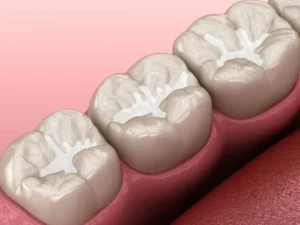
The starting point for most patients replacing amalgam is a mercury-free composite filling. There is no metal involved, no mechanical undercut cut into the tooth. Composite adheres directly to enamel. The preparation is less destructive than amalgam, and more of the original tooth stays intact. For chewing surface damage that goes further, we mill a ceramic inlay or onlay from zirconia or porcelain, custom-fit to the tooth. Precise. Conservative. When a tooth has lost enough structure to need a full crown, we design and mill a same-day ceramic crown using the CAD/CAM equipment at our Springfield dental technology center and place it the same appointment.
For patients who are missing teeth, an all-ceramic bridge replaces one or more with a porcelain structure anchored to adjacent teeth, no metal framework involved. Every restoration is shade-matched to the surrounding dentition. It looks like a tooth, because that is the point.
Ceramic Implants vs. Titanium Implants
Titanium implants are the most widely placed system in implant dentistry, and they have a strong long-term record. They are also metal. For patients with nickel hypersensitivity, titanium sensitivity, or autoimmune conditions, or for anyone who simply prefers no metal in the body at all, there is a ceramic option worth knowing about.
All-ceramic dental implants are made from zirconia throughout: post, abutment, crown. Zirconia osseointegrates well. It does not release metal ions. Zirconia is also white, so when gum tissue recedes over the years there is no gray metallic margin appearing at the gumline the way there would be with a titanium implant. Dr. Knapton is one of a small number of dentists in this region certified with Swiss Dental Solutions, offering the Straumann PURE ceramic implant system for patients who want a titanium-free option. Our dental implants in Springfield page has full information on both systems and candidacy requirements.
Do Metal-Free Restorations Hold Up?
Twenty years is a realistic working lifespan for a zirconia crown placed and maintained well. Some run longer. Composite resin fillings average 7 to 10 years, though newer bonding agents have been pushing that number up. In both cases, what determines how long a restoration lasts is mostly fit.
Amalgam requires mechanical retention, meaning the dentist cuts the tooth into a shape the filling can grip. Composite does not need that. It bonds directly to enamel, which means less removal of original tooth at placement. Every time a filling is replaced, you start from a slightly smaller tooth. Over multiple restoration cycles across a lifetime, the difference compounds. Composite leaves more behind each time.
Margin quality is the other variable. A gap where the edge of a restoration meets the tooth is where bacteria get in, and secondary decay is how most restorations eventually fail. Digitally milled ceramics fit to tighter tolerances than lab-fabricated options because the margin is designed and milled in the same sequence. Fewer gaps, less secondary decay risk, longer lifespan overall. A crown that fits well on a well-prepared tooth can go twenty years or more.
Who Is a Good Candidate for Metal-Free Dentistry?
Most patients are. The question is usually about priorities, whether the concern is health, aesthetics, allergy, or something else. Patients who tend to benefit most include people who:
- Have existing amalgam fillings they want replaced for health, cosmetic, or preventive reasons
- Have a documented metal allergy or sensitivity that causes oral or systemic symptoms
- Have autoimmune or thyroid conditions potentially linked to heavy metal exposure
- Prefer tooth-colored restorations in all areas of the mouth, including back teeth
- Are looking for a titanium-free implant option due to allergy testing or personal preference
- Need durable back-tooth restorations and want a material built for molar forces
The evaluation reviews the clinical status of existing restorations alongside the patient’s health history. Not every old amalgam filling needs to come out immediately. Dr. Knapton gives patients an honest picture of what is in their mouth and lets them decide what to do next.
Thinking About Making a Change to Your Dental Health?
Club K Dental offers a holistic, whole-body approach to dentistry in Springfield, MO. Whether you're exploring ceramic implants, fluoride-free care, or simply looking for a dentist who listens — we'd love to meet you.
Making the Transition to Metal-Free Dentistry
Drilling out amalgam is not as simple as it sounds. The removal process itself releases mercury vapor, and without the right precautions, the exposure during removal can temporarily exceed what you would get from leaving the filling in place. Club K Dental follows Safe SMART protocol mercury removal guidelines established by the IAOMT: the filling is cut into large chunks rather than ground, high-volume evacuation pulls particles away from the patient, supplemental oxygen is provided throughout, and physical barriers keep mercury particles out of the airway. Air filtration runs in the room the entire time.
Some patients with complex histories have cavitation lesions in the jawbone, areas of impaired bone healing that can be a factor in persistent symptoms even after amalgam is removed. We offer cavitation evaluation with cone beam CT imaging for patients whose picture points toward it. Most patients transitioning out of amalgam do not need that step. For those who do, the imaging tells us more about the bone before we decide how to proceed.
Experience the Club K Holistic Dental Difference
Dr. Joshua Knapton, DMD holds both a DMD and MBA from Roseman University of Health Sciences and maintains membership in the IAOMT and the AGD. He is the only biological dentist within an hour of Springfield offering the full spectrum of metal-free restorative services under one roof, from composite fillings to all-ceramic implants. His approach comes down to this: what you put in your mouth is a clinical decision, and it should be treated like one.
When you are ready to take a closer look at what is in your mouth, contact our office to schedule a consultation with Dr. Knapton.
Frequently Asked Questions About Metal-Free Dental Restorations
What is a metal-free dental restoration?
A metal-free dental restoration is any repair or replacement that uses non-metallic materials such as ceramic, zirconia, composite resin, or porcelain rather than amalgam, gold alloys, or metal-based crowns. The category includes composite resin fillings, ceramic inlays and onlays, all-porcelain crowns, zirconia bridges, and ceramic dental implants. None of these materials corrode, and none of them raise mercury or metal ion exposure concerns the way traditional metal restorations can.
How long do ceramic restorations last?
Most zirconia crowns and ceramic onlays are still functional at 15 years, and many reach 20 or beyond. Composite resin fillings average 7 to 10 years, though longevity depends on the size and location of the restoration and the patient’s bite habits. Modern ceramic materials are stain-resistant and do not corrode over time the way metal restorations do. Digitally milled ceramics fit more precisely than lab-fabricated work, which means fewer marginal gaps and less secondary decay, the main reason restorations fail over time.
Are metal-free restorations strong enough for back teeth?
Yes. Zirconia is harder than steel and is used routinely in posterior crowns, implant abutments, and multi-unit bridges where chewing forces are highest. The material handles molar forces well. Composite resin is appropriate for smaller back-tooth restorations. For larger posterior work that sees a lot of force, ceramic is typically the better long-term call. Which material gets used depends on the size, location, and clinical picture of each individual tooth.
Does dental insurance cover metal-free restorations?
Coverage varies by plan. Many dental insurance policies cover composite resin fillings on front teeth fully but limit back-tooth coverage to the cost of an amalgam filling, requiring the patient to pay the difference for tooth-colored material. Ceramic crowns are generally covered at rates comparable to metal-based crowns. Ceramic implants may or may not be covered depending on the specific plan. Contact our office before your appointment for a benefits review so you have a clear picture of out-of-pocket costs in advance.
Is it safe to have old amalgam fillings removed?
It can be, provided the removal is done with the right precautions in place. Drilling out amalgam releases mercury vapor, and without protective measures the exposure during removal can temporarily exceed ongoing exposure from an intact filling. Club K Dental uses SMART protocol for all amalgam removal: the filling is sectioned rather than ground, high-volume evacuation is used throughout, supplemental oxygen is provided to the patient, physical barriers protect the airway, and the operatory runs air filtration during the procedure. Patients who are pregnant, nursing, or have kidney conditions should speak with their physician before scheduling elective amalgam removal.
About the Author
Biological Dentist, Club K Dental, Springfield, MO
Dr. Knapton is the only biological dentist within an hour of Springfield, Missouri who offers the full spectrum of metal-free restorative services, from mercury-free fillings to ceramic inlays, all-ceramic bridges, same-day ceramic crowns, and Swiss Dental Solutions ceramic implants. His DMD and MBA from Roseman University of Health Sciences, combined with his IAOMT membership and AGD membership, reflect both clinical precision and a genuine commitment to whole-body health.